Choose the Right Wildflowers for Your Southwest Region
The Southwest isn’t one-size-fits-all when it comes to growing wildflowers. Elevation, rainfall, temperature, and soil conditions can vary dramatically—from low desert valleys to high mountain meadows. To make choosing the right mix easier, Desert Roots Nursery has put together seed mixes featuring resilient native and Southwest-adapted wildflowers selected for each of the Southwest's three growing regions. Each regional mix features seeds chosen to thrive in the conditions of that zone.
Find your region below to choose the wildflower seed mix designed for your Southwest landscape.
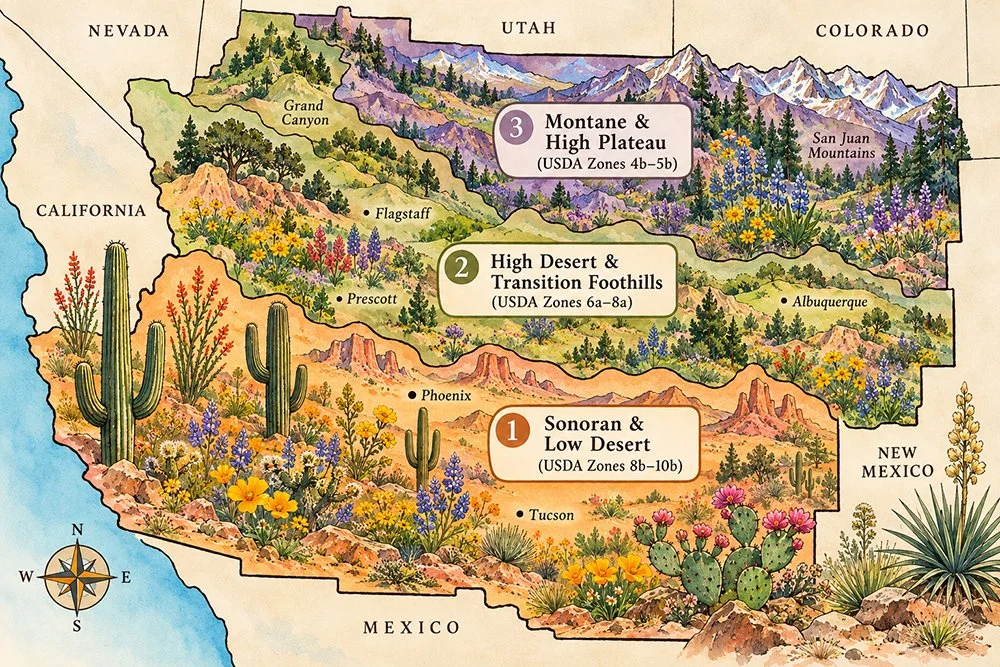
Region 1: Low Desert Basins — USDA Zones 8b–11a
Key Cities:
Arizona: Bullhead City; Casa Grande; Chandler; Gilbert; Lake Havasu City; Phoenix; Scottsdale; Yuma
California: Blythe; Coachella; El Centro; Indio; Palm Desert; Palm Springs
Nevada: Boulder City; Laughlin; Las Vegas; Mesquite
Climate & Gardening Conditions:
Low desert basins have extremely hot, long summers, mild winters, intense sunlight, and relatively low annual rainfall. Precipitation is often concentrated in two seasonal periods: cool-season winter rains and summer monsoon storms. Summer heat can become extreme enough to rapidly dry the soil and stress or kill plants that are not adapted to desert conditions. High evaporation rates create a challenging environment for moisture-sensitive plants.
Garden soils commonly range from sandy and gravelly soils to heavy clay and caliche, and many are alkaline with limited organic matter. Successful gardening in this region depends heavily on selecting plants adapted to heat, drought, intense sun, alkaline soils, and rapid shifts between wet and dry conditions. The relatively mild winter allows many desert-adapted plants to grow during the cooler months before summer temperatures become extreme.
Recommended Wildflowers (plant in the fall):
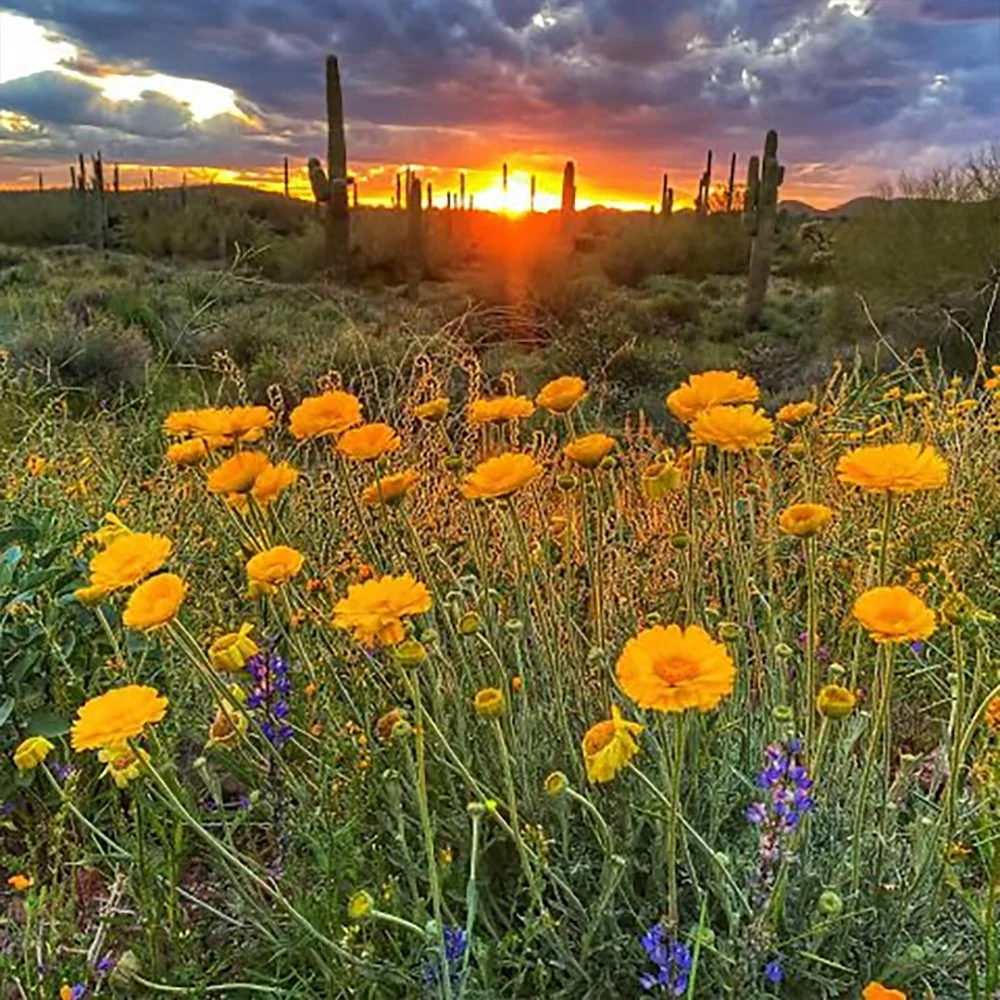
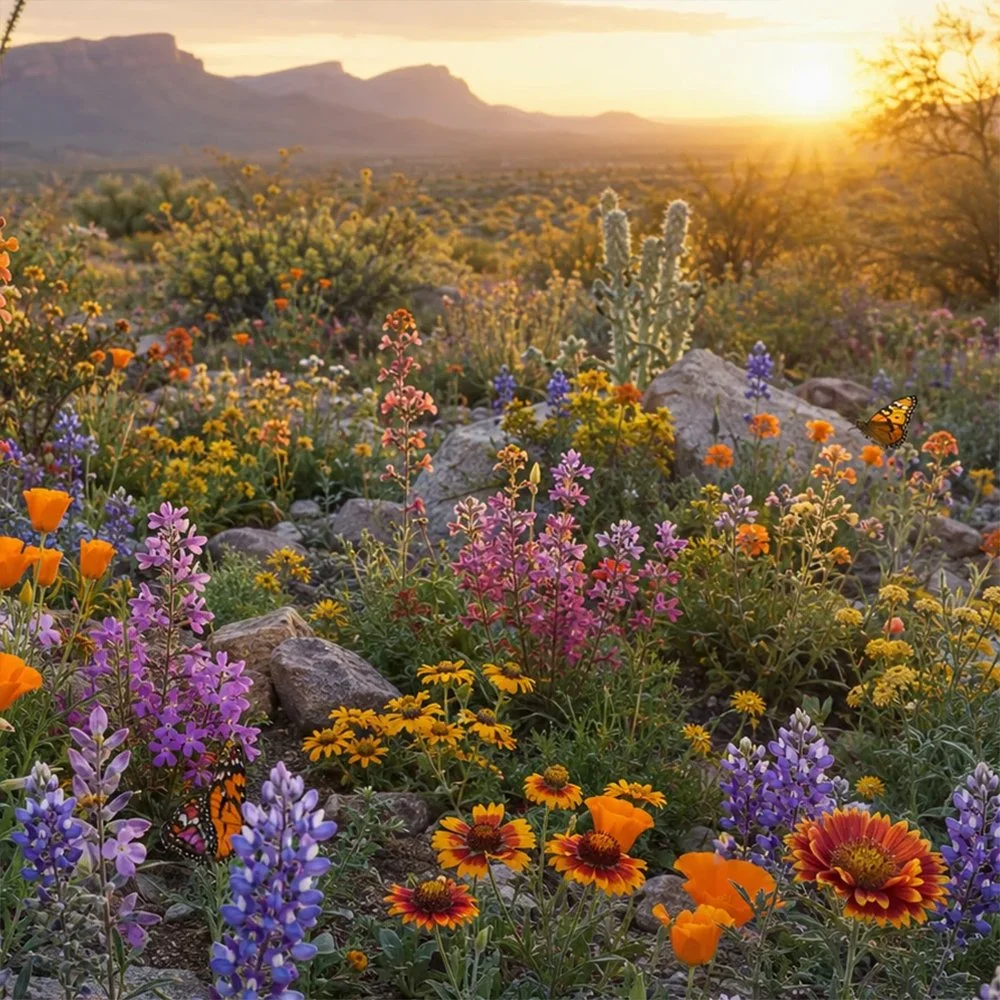
Arizona Lupine (Lupinus arizonicus) — A classic Sonoran Desert annual with brilliant blue-purple flower spikes that can create spectacular displays following good winter rains.
Desert Chia (Salvia columbariae) — A heat- and drought-adapted annual with distinctive rounded clusters of deep blue to purple flowers that provide valuable nectar for native pollinators.
Desert Bluebells (Phacelia campanularia) — A compact desert annual with intensely blue, bell-shaped flowers that create brilliant spring color and attract bees and other pollinators.
Desert Globemallow (Sphaeralcea ambigua) — A long-lived, drought-tolerant perennial with silvery foliage and apricot-orange flowers that can bloom repeatedly during favorable weather.
Desert Marigold (Baileya multiradiata) — A tough desert perennial with silvery foliage and bright yellow, daisy-like flowers that tolerates intense heat, drought, and poor soils.
Firewheel / Indian Blanket (Gaillardia pulchella) — A colorful native wildflower with striking red-and-yellow daisy-like blooms that thrives in full sun and attracts bees, butterflies, and other pollinators.
Mexican Gold Poppy (Eschscholzia californica ssp. mexicana) — One of the Southwest’s signature spring wildflowers, producing brilliant golden-orange blooms that can blanket desert landscapes following favorable winter rainfall.
Parry’s Penstemon (Penstemon parryi) — A striking Sonoran Desert perennial with tall spikes of vivid pink flowers that provide an important early-season nectar source for hummingbirds.
Region 2: High Desert & Transition Foothills — USDA Zones 6a–8a
Key Cities:
Arizona: Bisbee; Flagstaff; Globe; Page; Prescott; Sedona; Sierra Vista; Show Low; Willcox
Nevada: Carson City; Elko; Fallon; Reno; Winnemucca
New Mexico: Albuquerque; Gallup; Roswell; Santa Fe
Utah: Moab; St. George
Climate & Gardening Conditions:
High-desert and transition regions have greater seasonal temperature variation, colder winters, shorter growing seasons, and more pronounced freezing periods than the low desert. Elevation creates significant differences in local climate, and conditions can range from relatively mild desert environments to areas that regularly experience snow and prolonged winter freezes.
Moisture is generally more seasonal than in wetter regions, with winter precipitation, snowfall, spring runoff, and occasional summer thunderstorms contributing to annual moisture. The combination of cold winters and dry summers strongly influences which plants can survive and thrive.
Soils vary widely but often include rocky, gravelly, sandy, alkaline, or clay-based soils, usually with relatively low organic matter. Regional gardening favors plants adapted to cold winters, intense sunlight, drought, alkaline soils, and dramatic temperature fluctuations. Transition zones can be particularly diverse because they may support plants from both desert and colder upland environments.
Recommended Wildflowers (plant in the fall):
Blanket Flower (Gaillardia aristata) — A colorful perennial with golden-yellow, daisy-like flowers, often accented by reddish centers. Its long-lasting summer blooms attract native bees, butterflies, and other beneficial pollinators.
Blue Flax (Linum lewisii) — A graceful perennial producing delicate sky-blue flowers above slender stems and fine foliage. Adds soft color and natural movement to sunny foothill gardens.
Pale Evening Primrose (Oenothera pallida) — A drought-tolerant perennial with large, fragrant white flowers that may develop a soft pink blush. Its evening-opening blooms attract moths and other nighttime pollinators.
Palmer’s Penstemon (Penstemon palmeri) — A striking Southwestern perennial with tall spikes of fragrant, pale pink to lavender tubular flowers that attract hummingbirds and native bees. Thrives in sunny locations with well-drained soils.
Purple Prairie Clover (Dalea purpurea) — A hardy perennial with distinctive cylindrical flower heads covered in tiny rosy-purple blossoms. Its deep roots provide drought tolerance, while its flowers attract native bees and butterflies.
Rocky Mountain Beeplant (Cleome serrulata, syn. Peritoma serrulata) — A fast-growing annual producing airy clusters of pink to lavender-purple flowers with prominent stamens. Its nectar-rich blooms attract bees, butterflies, and hummingbirds.
Showy Goldeneye (Heliomeris multiflora) — A hardy Southwestern perennial with abundant golden-yellow, sunflower-like flowers on branching stems. Thrives in sunny foothill habitats and attracts native bees, butterflies, and other beneficial insects.
Western Yarrow (Achillea millefolium var. occidentalis) — A resilient native perennial with finely divided, fernlike foliage and broad clusters of tiny white to cream flowers. Attracts native bees, butterflies, and beneficial insects.Region 3: Montane & High Plateau — USDA Zones 4b–5b
Key Cities:
Colorado: Alamosa; Gunnison; Leadville; Steamboat Springs
Nevada: Baker; Elko; Ely; Wells
New Mexico: Chama
Utah: Park City; Vernal
Climate & Gardening Conditions:
Montane and high-plateau regions have cold, snowy winters, short growing seasons, late spring frosts, cool summers, and large day-to-night temperature swings. Snowpack may persist for extended periods, creating a prolonged period of dormancy followed by a relatively short growing season once temperatures rise.
Spring temperatures can fluctuate considerably, and hard frosts may occur well into late spring. Summers are generally cooler than those of desert regions, although high-elevation sunlight can be intense, and soils can dry rapidly during prolonged summer weather.
Garden soils are often rocky, gravelly, sandy, or relatively low in organic matter, although local conditions vary considerably. Successful gardening in these areas favors plants adapted to cold temperatures, snow cover, short growing seasons, intense sunlight, well-drained soils, and substantial seasonal temperature fluctuations.
Recommended Wildflowers (plant in the fall):
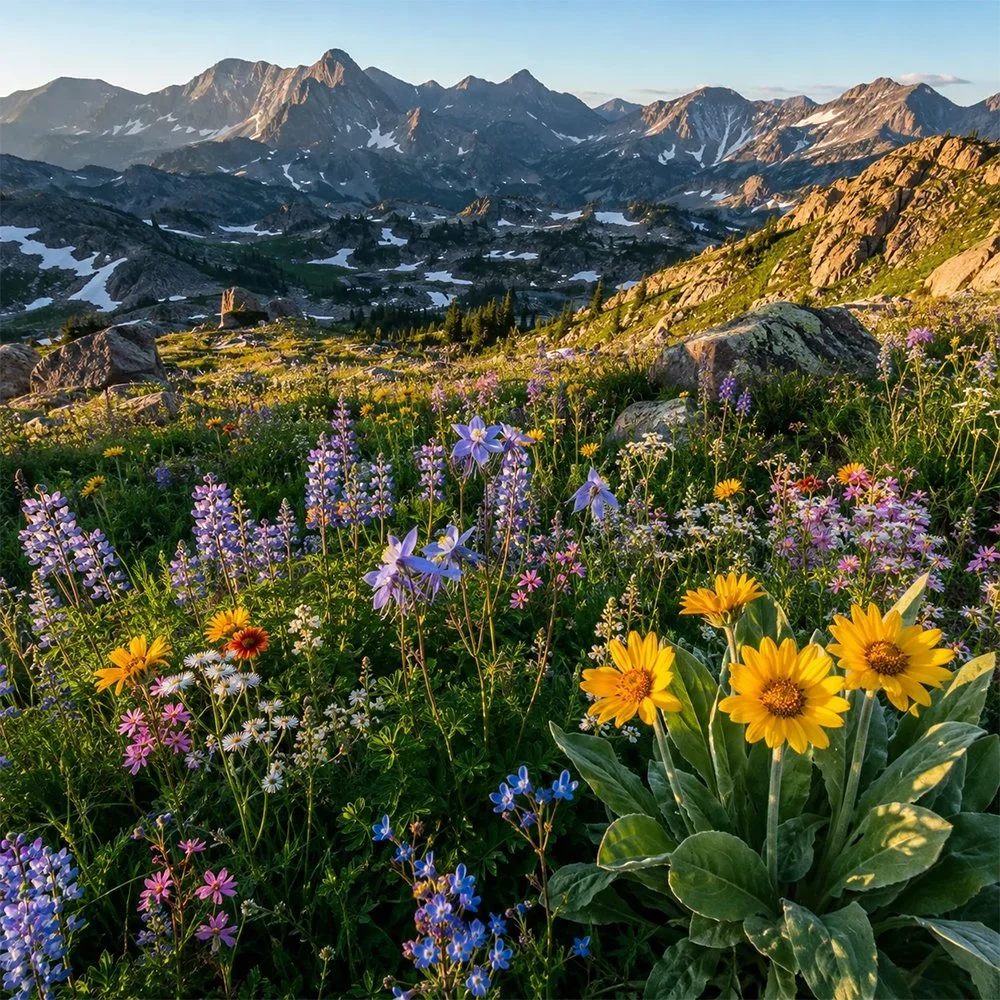
Arrowleaf Balsamroot (Balsamorhiza sagittata) — A hardy mountain perennial with large, golden-yellow sunflower-like blooms and silvery-green, arrow-shaped leaves. Thrives on sunny slopes and well-drained upland soils.
Aspen Fleabane / Showy Fleabane (Erigeron speciosus) — A colorful perennial producing lavender-blue, yellow-centered flowers that attract native bees, butterflies, and other pollinators.
Black-Eyed Susan (Rudbeckia hirta) — A cheerful wildflower with golden-yellow petals and prominent dark centers. Its summer blooms attract bees, butterflies, and beneficial insects.
Colorado Blue Columbine (Aquilegia coerulea) — A Rocky Mountain perennial with distinctive blue-violet and white flowers that provide nectar for hummingbirds and native pollinators. Prefers cooler sites with some moisture.
Firecracker Penstemon (Penstemon eatonii) — A striking Southwestern perennial with tall spikes of brilliant scarlet-red tubular flowers that attract hummingbirds. Native to rocky slopes, open woodlands, and high-desert mountain habitats, it thrives in full sun and well-drained soils and tolerates cold winters.
Rocky Mountain Penstemon (Penstemon strictus) — A western mountain perennial with upright spikes of deep blue to violet-purple tubular flowers that attract hummingbirds and native bees.
Silvery Lupine (Lupinus argenteus) — A hardy perennial with silvery-green foliage and upright spikes of blue to violet flowers. Well suited to open mountain meadows and rocky slopes.
Wild Bergamot (Monarda fistulosa) — An aromatic perennial with lavender-pink flower clusters that attract bees, butterflies, and hummingbirds.
Why Should Southwestern Wildflowers be Planted in the Fall?
Fall is the best time to sow wildflower seed in the Southwest because it follows their natural life cycle. In the low and intermediate deserts, cooler fall and winter weather combined with seasonal rainfall gives seeds time to absorb moisture and germinate without the stress of extreme summer heat. Young plants can spend the cooler months developing roots, then grow rapidly and flower as temperatures warm in late winter and spring. Fall sowing also allows seeds that need a period of cool, moist conditions to receive that treatment naturally outdoors. In higher-elevation areas, seeds may remain dormant beneath cold temperatures or snow through winter and germinate when conditions become favorable in spring. By sowing in fall, gardeners let seasonal temperature changes and winter moisture do much of the work, resulting in stronger establishment and a more natural spring wildflower display.