
Rooted in Curiosity – Where Botany Meets Wonder
The Genetic Mystery Box: Why Don’t Hybrid Plant Seeds Grow "True"?
If you’ve ever fallen in love with a stunning, unique plant in your garden, you might be tempted to harvest its seeds to grow exact copies. It sounds like the perfect way to expand your plant collection for free! But if your favorite plant is a hybrid, there is a fascinating biological catch: seeds harvested from a hybrid plant will not grow "true" to the parent.
Here is a simple look at the science behind why hybrid seeds are a genetic surprise, and how you can actually get exact copies of your favorite plants.
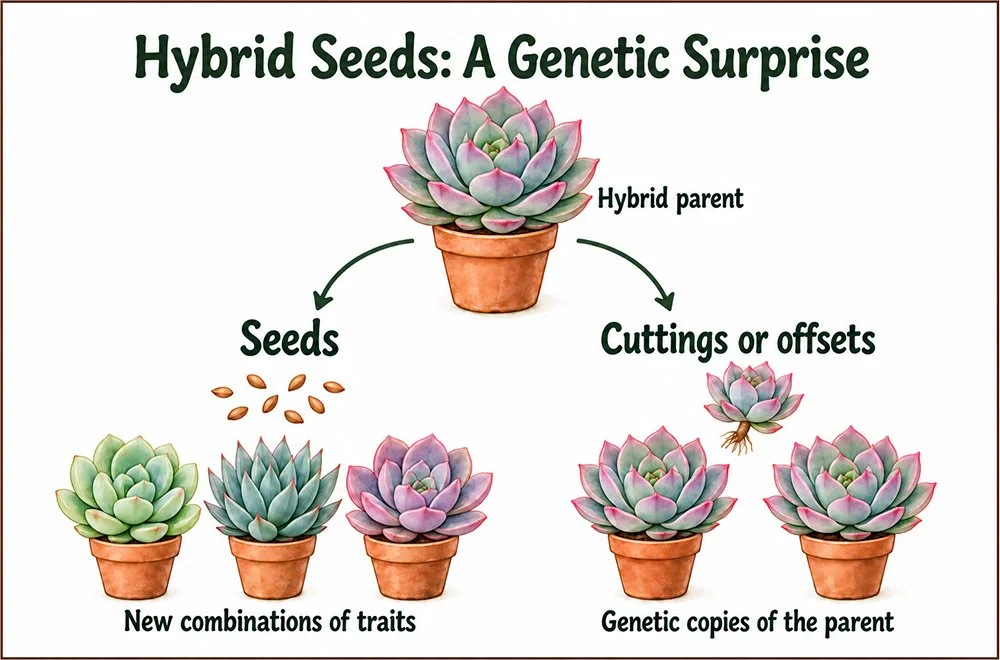
The Ultimate Genetic Shuffle
A hybrid plant is created by cross-breeding two or more distinct parent plants to combine their best traits—like unique colors, pest resistance, or larger blooms.
Think of it like human family traits. If a child inherits their mother's curly hair and their father's green eyes, they have a beautiful, unique combination. But when that child grows up and has their own children, the DNA shuffles all over again.
When a hybrid plant produces seeds, its blended traits separate and recombine at random. This is called genetic splitting. Instead of a perfect copy of the hybrid, the seedlings will "revert," meaning they might look exactly like one of the original grandparents, or turn into a completely unpredictable mystery mix!
Bees Make a Mess of the DNA
For a plant to produce seeds, its flowers must be pollinated. Out in the open garden, insects carry pollen from plant to plant. If a bee visits a completely different variety of plant down the street and then flies over to your hybrid, the resulting seeds are a brand-new, accidental cross-breed. You won't know what you've created until the seeds sprout and grow.
"F1" vs. "Heirloom" Seeds
This is why commercial seed packets are often labeled F1 Hybrid. Professional growers meticulously create these first-generation seeds by hand-pollinating the original parents in a controlled environment to ensure a uniform crop. If you save the seeds produced by that F1 plant, you are growing the "F2" generation, which is where the wild genetic chaos happens. Only heirloom (or open-pollinated) plants can reliably produce seeds that look exactly like the parent, because their genetics have been stabilized over many generations.
The Solution? Cloning, Not Sowing
If you want a new plant that is a 100% identical match to your favorite hybrid, you have to bypass seeds entirely and use vegetative propagation.
Depending on the plant, this means taking:
Stem or leaf cuttings
Root divisions
Offsets (pups)
Because these methods use the parent plant's actual tissue, they share identical DNA. Propagating this way gives you a perfect, guaranteed clone every single time.